The Salgi Esophageal Cancer Research Foundation has awarded funding for esophageal cancer research in July 2025; the fourth time in less than 13 years since the charity was founded.
The Salgi Esophageal Cancer Research Foundation issued not one, not two, not three but FOUR grants for esophageal cancer research.
In 2011, The Salgi Esophageal Cancer Research Foundation was established to raise awareness, encourage early detection and to fund research of esophageal cancer. Since 2011, the foundation has both raised awareness and encouraged the importance of earliest possible detection across the United States and internationally. The Salgi Esophageal Cancer Research Foundation awarded its first grant for esophageal cancer research in July 2015 and awarded a second grant in November 2018.
Then, in June 2023, The Salgi Foundation awarded three grants for esophageal cancer research.
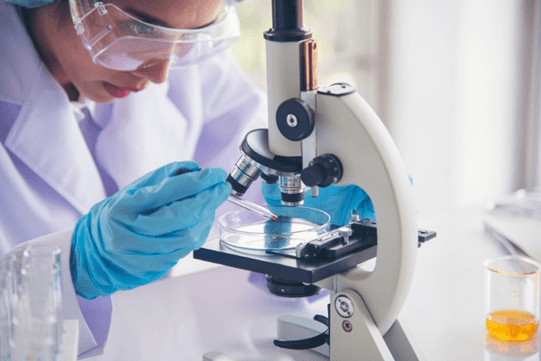
The Salgi Esophageal Cancer Research Foundation awarded research funding to Dr. Haeseong Park and Dana Farber Cancer Institute in the amount of $50,000.00 for the project titled: ““Combination of trastuzumab deruxtecan and neratinib in HER2-expressing gastroesophageal cancers.”
Dr. Park’s research seeks to “generate the preclinical data necessary to justify a novel therapeutic strategy for HER2-positive esophageal cancer.”
The Salgi Esophageal Cancer Research Foundation also awarded research funding to Dr. Masood Shammas and Dana Farber Cancer Institute in the amount of $71,039.00 for the project titled: “Targeting a kinase and a nuclease (TTK/APEXI) pair to overcome chemoresistance and immune dysregulation in esophageal adenocarcinoma.”
Dr. Shammas’s research seeks to “modulate TTK/APE1 both alone and in combination in EAC cell lines and normal cell types and to investigate impact on various cellular and molecular characteristics.”
The Salgi Esophageal Cancer Research Foundation also awarded research funding to Dr. Ni Shi and Dr. Fred Tabung and The Ohio State University in the amount of $61,987.00 for the project titled: “Integration of multi-risk factor polygenic score with anti-inflammatory dietary pattern for esophageal cancer prevention.”
Dr. Shi and Dr. Tabung’s research seeks to “investigate how dietary pattern rEDIP interacts with an individual’s genetic risk for esophageal cancer using existing dietary and genomic data from multiple well-characterized cohorts.”
The Salgi Esophageal Cancer Research Foundation also awarded research funding to Dr. Tilak Shah and The Cleveland Clinic in the amount of $66,140.00 for the project titled: “Phase 2 randomized trial of neoadjuvant spray cryotherapy prior to neoadjuvant FLOT in locally advanced esophageal adenocarcinoma.”
Dr. Shah’s research seeks to “assess whether liquid nitrogen spray cryotherapy (LNSC) can increase cure rates with neoadjuvant chemotherapy.”
Learn the Facts About Esophageal Cancer
One of the primary risk factors associated with esophageal cancer is Gastroesophageal Reflux Disease, also known as GERD or acid reflux disease, of which the most common symptom is chronic heartburn. Other risk factors include obesity, heavy drinking, poor nutrition and smoking and/or use of tobacco products.
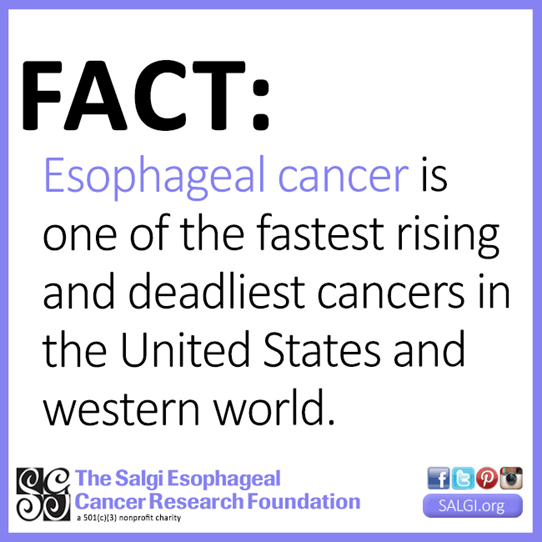
With over a 733% increase in the past four decades, esophageal cancer is among the fastest growing and deadliest cancers in the United States and the western world.1
There are no current standard or routine screenings to detect esophageal cancer in its earlier stages. Currently, guidelines for referral for endoscopy occur when warning symptoms appear.
These warning symptoms, such as difficulty swallowing, typically appear once the cancer has become advanced. This, in addition with other factors mentioned, leads to the current overall five-year survival rate of only 21.9%.2 Despite its rapid increase and poor prognosis, esophageal cancer receives insufficient awareness and research funding.
The Salgi Foundation: Past Esophageal Cancer Research Funding
In 2023, The Salgi Esophageal Cancer Research Foundation awarded research funding to Dr. Matthew Stachler and The Regents of the University of California in the amount of $44,742.00 for the project titled: “Determination of inflammatory influences on progression of Barrett’s esophagus and invasive esophageal adenocarcinoma.”
Dr. Stachler’s research seeks to “understand what drives the progression of preneoplastic disease into invasive cancer by applying the many systems developed for studying advanced cancer to premalignant conditions in early evasive disease with Barrett’s esophagus and esophageal adenocarcinoma being a major focus.”
In 2023, The Salgi Esophageal Cancer Research Foundation also awarded research funding to Dr. Nathan Parker and H. Lee Moffitt Cancer Center & Research Institute, Inc., in the amount of $30,000.00 for the project titled: “Exercise prehabilitation for locoregional esophageal cancer.”
Dr. Parker’s research will “evaluate the feasibility and acceptability of PA and RT exercise prehabilitation components among patients preparing for LEC resection; to examine changes in exploratory outcomes over the course of exercise prehabilitation and recovery following therapy and to compare clinical and treatment outcomes to those of a retrospectively identified comparison group that received no formal exercise prehabilitation programming.”
Lastly, in 2023, The Salgi Esophageal Cancer Research Foundation also awarded research funding to Dr. Sazzad Hassan and Indiana University in the amount of $50,000.00 for the project titled: “Overcoming resistance to HER2-targeted therapies in esophageal adenocarcinoma.”
Dr. Hassan’s research will “investigate whether acquired lapatinib resistance in esophageal adenocarcinoma is due to down regulation of heat shock protein 40. These studies might pave the way toward the use of HSP40-glycolytic enzymes interaction targeting as an innovative therapeutic approach to overcome lapatinib resistance.”
In 2018, The Salgi Esophageal Cancer Research Foundation awarded principal investigator, Dr. Donald Low and Virginia Mason Medical Center, grant funding. Dr. George Hanna of St Mary’s Hospital (Imperial College London) is co-investigator.
The research, which is currently underway, intends to establish a non-invasive test for the detection of esophageal cancer that is based upon the unique signature of volatile organic compounds (VOCs) within exhaled breath and to analyze exhaled VOCs in response to therapeutic intervention in patients.
In 2015, The Salgi Esophageal Cancer Research Foundation issued esophageal cancer research funding to Program Director Dr. Carlos Minacapelli and Rutgers Robert Wood Johnston Medical School. That research was presented as a poster presentation during Digestive Disease Week in May, 2017.
The Salgi Esophageal Cancer Research Foundation would like to thank all our supporters and donors who believe in this mission and who make these accomplishments possible. However, this is just the beginning. The Salgi Esophageal Cancer Research Foundation continuously receives many requests for esophageal cancer research. We need to continue our efforts to fundraise so that we may continue to fulfill this mission to raise awareness, encourage early detection and fund research.
To make a tax-deductible donation to The Salgi Esophageal Cancer Research Foundation, please visit: SALGI.org/donate.

The Salgi Esophageal Cancer Research Foundation is a 501(c)(3) nonprofit as recognized by the IRS.


 Posted by salgiblogs

 The Salgi Esophageal Cancer Research Foundation