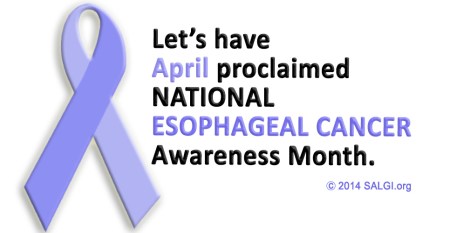
Let’s have April named ‘National Esophageal Cancer Awareness Month!’

April 28, 2014

We, The Salgi Esophageal Cancer Research Foundation started the petition: “President of the United States: Proclaim the Month of April to be ‘Esophageal Cancer Awareness Month’ in The United States of America” and need your help to get it off the ground.

Please take a moment to sign the petition now. Click here!

Here’s why it’s important:

Esophageal cancer has increased over 600% in the past decades, making it the fastest growing cancer in the United States.

Many do not realize that among other risk factors, obesity, chronic heartburn or Gastroesophageal Reflux Disease (GERD) and smoking can lead to esophageal damage and cancer.

Despite its rapid increase and poor prognosis, esophageal cancer research receives very little private or government funding.

In fact, the National Cancer Institute decreased its investment in research of esophageal cancer by 15% in 2012.

Esophageal cancer research receives a mere $28.0 million out of NCI’s total $5.07 billion budget; that’s approximately half of one percent.

However, approximately $1.3 billion dollars is spent on esophageal cancer treatment each year in the U.S.

While it is currently only the 18th most common cancer, Stage IV EAC only has a 3% survival rate.

Esophageal cancer shows low survival rates even in early stages: 21%-39%.

Esophageal cancer is a lethal diagnosis. Symptoms often arise too late, once the cancer has spread and becomes difficult if not impossible to treat.

Please, sign and share this petition! Click here!

APRIL is esophageal cancer awareness month every day is esophageal cancer awareness day periwinkle allperiwinkleverything health


The Salgi Esophageal Cancer Research Foundation is a 501 (c) (3) non profit organization as recognized by the Internal Revenue Service.

Content found on Salgi.org is for informational purposes only. The Content is not intended to be a substitute for professional medical advice, diagnosis, or treatment. Seek the advice of your physician or other qualified health provider with any questions you may have regarding a medical condition.

Did you miss our #EsophagealCancer Twitter Chat?

April 17, 2014

On Tuesday, April 8th, The Salgi Esophageal Cancer Research Foundation teamed up with medical experts from around the web to answer your important questions regarding prevention, detection, diagnosis, and treatment of esophageal cancer.  If you missed the chat, not to worry!  We’ve put together the complete transcript from the #EsophagealCancer Twitter chat.

This was the very first chat dedicated to #EsophagealCancer and we are very excited to share the important information that was discussed that day!  We will be hosting more Twitter Chats dedicated to esophageal cancer in the future, so if there is a question that was not answered, please contact us and let us know what you want answered at the next #EsophagealCancer Twitter Chat!

Question 1:

@SalgiFoundation: Q1. Explain the differences between esophageal adenocarcinoma and squamous cell carcinoma. #EsophagealCancer

Answers:

@RoswellPark: A1. Beside microscopic differences, adeno tends to be low down near the stomach while squamous arises in the upper portions #EsophagealCancer

@RoswellPark: A1. Squamous often occurs w/ irritation/ingestion of alcohol, tobacco, irritating foods & environmental factors #EsophagealCancer

@UCD_ChestHealth: A1. Adeno EsophagealCancer often occurs @ the bottom of esoph, caused by GERD. Squamous mid & top of esoph. Caused by smoking & alcohol.

@UCD_ChestHealth: A1. Squamous #EsophagealCancer can also be caused by chronic irritation problems like Achalasia and caustic injury

@UCD_ChestHealth: A1. Consumption of foods high in nitrates can also cause Squamous #EsophagealCancer

@RefluxMD: A1. Our Scientific Director, Dr. Para Chandrasoma, wrote a great article on this subject – refluxmd.com/learn/resource #EsophagealCancer

Question 2:

@SalgiFoundation: Q2. What are the risk factors associated with esophageal adenocarcinoma? #EsophagealCancer

Answers:

@RoswellPark: A2. Besides the other factors, the chronic irritation/changes of stomach juices cause adenocarcinomas over time #EsophagealCancer

@UCD_ChestHealth: A2. Acid reflux or GERD is a big risk factor for adenocarcinoma #EsophagealCancer. Causes Barrett’s which can degenerate into cancer

@UCD_ChestHealth: A2. Yes, food sits in esoph, and irritates lining > RT : Achalasia is a swallowing disorder? #EsophagealCancer

@UCD_ChestHealth: A2. Obesity also is a risk factor for Adeno #EsophagealCancer, mainly because obesity can lead to acid reflux

@UCD_ChestHealth: A2. Yes Barrett’s > low grade dysplasia > high grade > adenocarcinoma MT: Barrett’s esophagus is a precancerous condition? #EsophagealCancer

@UCD_ChestHealth: A2. Yes, leads to acid reflux > injury > Barrett’s RT : So, would a hiatal (sp?) hernia be a risk factor for #EsophagealCancer?

@AmerGastroAssn: A2. Overall diet, rather than specific foods, affect risk for #EsophagealCancer. More info: ow.ly/vzruO

@DanaFarber: A2.  Obesity, Barrett’s esophagus, smoking, and being male are all risk factors for #EsophagealCancer. bit.ly/1mUwWHf

@BrendonStilesMD: A2. Adeno. Some links with reflux disease and obesity. Probably some genetic factors that need to be better explored. #EsophagealCancer

@Aiims1742: A2. Risk factors include Barrett esophagus (most important) high BMI, alcohol smoking @SalgiFoundation#EsophagealCancer

Question 3:

@SalgiFoundation: Q3. What is Gastroesophageal Reflux Disease (GERD) and how is it related to esophageal cancer#EsophagealCancer

Answers:

@RoswellPark: A3. GERD is symptoms (heartburn) or damage caused by stomach juice spending too much time in the esophagus. #EsophagealCancer

@RoswellPark: A3. Over time, the acid juices can burn to produce a precancerous (Barrett’s) change or simply induce cancers directly. #EsophagealCancer

@UCD_ChestHealth: A3. GERD = gastroesophageal reflux disease, or spilling of acid from stomach to esoph. This leads > Barrett’s, which can cause #EsophagealCancer

@UCD_ChestHealth: A3. If one has GERD symptoms that do no respond to PPI after 4-8 weeks, they should get screening endoscopy per ACP. #EsophagealCancer

@AmerGastroAssn: A3. GERD = heartburn occurring when acid or other stomach contents back up in the esophagus. #EsophagealCancer ow.ly/vzsdO

@DanaFarberA3. GERD is backward flow of stomach acid contents into the esophagus – another risk factor for #EsophagealCancer. bit.ly/1mUwWHf

@BrendonStilesMD: A3. Reflux leads to chronic inflammation and injury, which may initiate/promote cancer growth. #EsophagealCancer

@BrendonStilesMD: A3. Important for people with GERD to be evaluated by GI doctors & considered for endoscopy, particularly with persistent sxs #EsophagealCancer

@BrendonStilesMD: A3. Q: @LungCancerFaces:  Do meds such as PPIs really lessen risk, or just treat symptoms? #EsophagealCancer

@BrendonStilesMD: A3. @SalgiFoundation @LungCancerFaces:  #EsophagealCancer Wish we knew. Some thought PPIs may even increase risk or mask symptoms.

Question 4:

@SalgiFoundation: Q4. Define Barrett’s Esophagus and explain how it is diagnosed. #EsophagealCancer

Answers:

@RoswellPark: A4. Barretts is damaged esophagus lining that gets recovered w/ a surface similar to the stomach #EsophagealCancer

@RoswellPark: A4. Treatment options for Barretts: goo.gl/ssF1Ft   #EsophagealCancer

@UCD_ChestHealth: A4: Barrett’s columnar epithelium w/ gobletcells (?) the esoph tries to look like intestine to protect itself from acid #EsophagealCancer

@UCD_ChestHealth: A4. Risk for adeno #EsophagealCancer is increased 30-125 fold for patients with Barrett’s metaplasia

@DanaFarber: A4. Barrett’s esophagus is a pre-cancerous or, in some cases, early form of #EsophagealCancer. bit.ly/1mUwWHf

@DanaFarberA4. Barrett’s esophagus often due to chronic inflamm from acid reflux & appears as abnormal cells lining the esophagus. #EsophagealCancer

@DanaFarberA4. If diagnosed, it’s important to treat Barrett’s esophagus to prevent the development of #EsophagealCancer.

@DanaFarberA4. Depending on form Barrett’s esophagus treatment may include medication, lifestyle changes, or radiofrequency ablation #EsophagealCancer

@DanaFarberA4. Q: @LungCancerFaces: @DanaFarber What is radiofrequency ablation?

@DanaFarber: A4. @LungCancerFaces: Great question! It’s a procedure that uses radio waves to heat and destroy abnormal cells.

@RefluxMD: A4. Quick overview by Dr. Chandrasoma of Barrett’s and diagnosis: refluxmd.com/connect/physic  #EsophagealCancer

@RefluxMD: A4. FYI – “If you’ve been diagnosed with Barrett’s” refluxmd.com/learn/resource  #EsophagealCancer

@BrendonStilesMD: A4. Barretts has to be diagnosed by endoscopic biopsy. Need to r/o dysplasia and cancer. Surveillance.

@Aiims1742: A4. Barrett esophagus is columnar epithelium with goblet cells within the tubular esophagus (sorry -GI Pathologist lingo) #EsophagealCancer

@Aiims1742: A4. Barrett esophagus shares many genetic alterations with esophageal cancer for example see Streppel, Maitra papers #EsophagealCancer

@Aiims1742: A4. GI Pathologists at MDAnderson and other places are looking for DYSPLASIA in biopsies of Barrett esophagus #EsophagealCancer

@Aiims1742: A4. patients with low grade Barrett dysplasia merit follow up, high grade need very close follow up or local ablation. #EsophagealCancer

Question 5:

@SalgiFoundation: Q5. Currently there are no standard/routine screening tests for EC, what are options to detect EC in early stages? #EsophagealCancer

Answers:

@RoswellPark: A5. Best option to detect EAC while curable/superficial is to find it w/ endoscopy. More on EUS: goo.gl/U6tI18#EsophagealCancer

@UCD_ChestHealth: A5. Everyone w/ Barrett’s should be in an endoscopic surveillance program ever 3 years

@UCD_ChestHealth: A5. Everyone with Barrett’s metaplasia should be in an endoscopic surveillance program at least every three years #EsophagealCancer

@UCD_ChestHealth: A5. Everyone should get a screening endoscopy if they have heartburn [GERD] + additional symptoms (e.g. trble swallowing) #EsophagealCancer

@UCD_ChestHealth: A5. Men over 50 with chronic GERD and additional risk factors should get screening endoscopy #EsophagealCancer

@LungCancerFaces: A5. Endoscopy is a breeze. Much easier than a colonoscopy. Don’t hesitate to do it if necessary. #EsophagealCancer

@AmerGastroAssn: A5. Researchers have developed markers to identify patients with BE at greatest risk for developing #EsophagealCancer http://agajournals.wordpress.com/2013/08/05/which-patients-with-barretts-esophagus-will-develop-esophageal-cancer/ 

@Aiims1742: A5. Most #EsophagealCancer  (adenocarcinoma) present with advanced dz while high grade Barrett or early EC do very well 

Question 6:

@SalgiFoundation: Q6. What are some warning signs associated with esophageal cancer#EsophagealCancer 

Answers:

@RoswellPark: A6. Difficulty with food because it “sticks” or causes pain during swallowing are the main symptoms of #EsophagealCancer 

@RoswellPark: A6. Unfortunately any symptom or sign means that the tumor has gotten quite large and is harder to treat. #EsophagealCancer 

@UCD_ChestHealth: A6. Difficulty swallowing. If your heart burn goes away for no reason, it may be a sign that Barrett’s has developed. #EsophagealCancer 

@UCD_ChestHealth: A6. Also black tarry stools, vomiting blood. Chronic anemia #EsophagealCancer 

@DanaFarberA6. The early stages of #EsophagealCancer  typically have no symptoms. As the disease advances, symptoms start to become more noticeable.

@DanaFarber: A6. Advanced #EsophagealCancer  symptoms include painful/difficult swallowing, weight loss, & regurgitation of food. bit.ly/1mUwWHf

@RefluxMD: A6. We recently spoke with a stage 4 cancer patient that only had uncontrolled burping after meals as a symptom. #EsophagealCancer 

@BrendonStilesMD: A6. Patients and physicians can’t ignore heartburn or difficulty swallowing. Low threshold for endoscopy.

Question 7:

@SalgiFoundation: Q7. What are methods of detection and diagnosis for esophageal cancer? #EsophagealCancer 

Answers:

@RoswellPark: A7. Tests like CT/PET Scans, ultrasound (on the endoscope), help to characterize the tumor & measure its spread #EsophagealCancer 

@UCD_ChestHealth: A7. Endoscopic screening and early detection can save lives bit.ly/YRUIDM#EsophagealCancer 

@UCD_ChestHealth: A7. Endoscopy goal standard for evaluation of potential #EsophagealCancer 

@AmerGastroAssn: A7. Patient brochure offers tips for preparing for an upper GI endoscopy: ow.ly/vzx6U#EsophagealCancer 

@DanaFarber: A7. Tests typically include chest X-rays, barium swallow, esophagoscopy, endoscopy, blood chemistry studies, CBC, or EUS. #EsophagealCancer 

@BrendonStilesMD: A7. EGD is a lot easier than colonoscopy. (And less messy and far to go!). More of an effort to find early.

@BrendonStilesMD: A7. Endoscopic biopsy. If cancer need endoscopic ultrasound to determine depth and bx nodes, CT, and PET.

Question 8:

@SalgiFoundation: Q8. When diagnosed with esophageal cancer what are available treatment options? #EsophagealCancer 

@SalgiFoundation: Q10. Stage IV survival rate is only 3%. What can be done to increase chances of survival? #EsophagealCancer 


The Salgi Esophageal Cancer Research Foundation is a 501 (c) (3) non profit organization as recognized by the Internal Revenue Service.

Content found on Salgi.org is for informational purposes only. The Content is not intended to be a substitute for professional medical advice, diagnosis, or treatment. Seek the advice of your physician or other qualified health provider with any questions you may have regarding a medical condition.


Eat your vegetables! Diet high in animal-based proteins linked to cancer, study shows.

March 5, 2014

Do you remember growing up and being told to “eat your vegetables”?  Well, new research suggests that those “veggie pushers” were onto something.  The Washington Post reports that researchers from the United States and Italy found that those whose diet was high in animal protein were four times more likely to die of cancer.  The same does not seem to show for plant-based protein sources.

Valter Longo, a University of Southern California gerontology professor and director of the school’s Longevity Institute believes that the majority of Americans are eating too much protein and are not choosing the right kind of protein.  This doesn’t come as a surprise since diets such as Atkins or Palseo, which encourage a protein rich diet have become very popular.  On the other hand, many plant-based protein sources contain some, but not all, essential amino acids.  Longo suggests maintaining a diet which consists of more plant-based proteins and to lower the daily intake of “animal-derived proteins.”

The growth hormone IGF-I has been shown to encourage the growth of both healthy and cancer cells.  This hormone is increased through the intake of protein.  Unfortunately, IGF-I levels typically decline after the age of 65 and attributes to the loss of muscle tone.  Since IGF-I is also responsible for the growth of healthy cells, a decrease in protein can be dangerous for those over 65.

Here are a list of plant-based foods that are high in protein:

Legumes (Soybeans, lentils, lupins, white beans, split peas, pintos, kidneys, black beans, navy beans and chickpeas.)

Leafy green vegetables (Bok choy, Romaine lettuce, escarole, kale and spinach.)

Root vegetables (Potato, sweet potato, parsnips, carrots and beets.)

Other vegetables (Peas, broccoli, asparagus, butternut squash, cauliflower.)

Since this post is intended for informational purposes only, the best way to maintain a well-balanced diet is to speak to a physician or a nutritionist.


For more information, please visit our sources: 

Washington Post
Forbes
Ehow.com
Foodmatters.tv 
 
The Salgi Esophageal Cancer Research Foundation is a 501 (c) (3) non profit organization as recognized by the Internal Revenue Service.

Content found on Salgi.org is for informational purposes only. The Content is not intended to be a substitute for professional medical advice, diagnosis, or treatment. Seek the advice of your physician or other qualified health provider with any questions you may have regarding a medical condition.


‘Missed Opportunities in GERD Complication Screenings’

January 30, 2014

High-risk patients don’t always get endoscopic examination for Barrett’s esophagus, cancer, say researchers.
Outpatient Surgery Magazine

Men aged 65 years and older are much more likely to suffer the complications of gastroesophageal reflux disease (GERD), such as Barrett’s esophagus and esophageal, gastric or duodenal cancer, but they’re much less likely to undergo endoscopic screenings that can detect these complications, according to recent research.

Go to full story in Outpatient Surgery here.


The Salgi Esophageal Cancer Research Foundation is a 501 (c) (3) non profit organization as recognized by the Internal Revenue Service.

Content found on Salgi.org is for informational purposes only. The Content is not intended to be a substitute for professional medical advice, diagnosis, or treatment. Seek the advice of your physician or other qualified health provider with any questions you may have regarding a medical condition.


How is esophageal cancer diagnosed?

January 28, 2014

 Upper gastrointestinal (GI) endoscopy

During this procedure, a doctor uses an endoscope to see the upper GI tract which consists of the esophagus, stomach and the first part of the small intestine.  An endoscope is a lightweight, flexible, hollow instrument equipped with a lens which allows the doctor to see these internal parts.  Examining the esophagus, the doctor is looking for any abnormalities; inflammation, areas which have been irritated, abnormal growths or cancer. The procedure is generally preformed while a patient is under sedation.  Sedation is not required for all patients as some receive minimal to no sedation.   Doctors utilize endoscopy procedures to also detect ulcers, abnormal growths in the stomach or first part of small intestines, bowel obstructions or hiatal hernias.  There are small risks associated with an endoscopy such as bleeding, tissue infection and tears in the gastrointestinal tract.  These are rare instances, the Mayo Clinic reports that the latter occurs in about three to five out of every 10,000 upper endoscopies.

X-Ray

Also, known as a barium swallow or esophagram, is an upper gastroentestional series of X-rays used to examine the esophagus for any abnormal conditions.  This test requires patient to drink a thick liquid that temporarily coats the lining of the esophagus.  This will highlight the lining of the esophagus clearly on the X-rays to help better detect any abnormality.

Biopsy

If during an endoscopy, doctors finds any suspicious tissue, they will use an endoscope (defined above) passed down the throat into the esophagus to collect a sample of the tissue.  This tissue sample is then sent to a laboratory which will look for cancer cells.

 Talk to your doctor if you experience heartburn more than twice a week, as that can be a symptom of Gastroesophageal Reflux Disease (GERD), which is one of the major risk factor for esophageal cancer.  Patients who experience GERD symptoms for more than five years and have other risk factors associated with esophageal cancer, such as being overweight or smoking, are at an elevated risk of developing esophageal cancer.

Unfortunately, esophageal cancer is often detected late because symptoms do not occur until the cancer has progressed. 

This is why we stress the importance of speaking to your doctor about your frequent GERD symptoms and discuss the different ways in which they can be controlled.  For many, lifestyle changes, such as monitoring food and beverage ‘reflux triggers’ and losing weight, can help alleviate acid reflux.  (Click here to read more tips on how to manage acid reflux.)

Too often, esophageal cancer is diagnosed at advanced and/or incurable stages due to the late onset of symptoms. This makes the cancer difficult if not impossible to treat and often results in 80% of patients diagnosed with esophageal cancer dying within the first year.

Let’s work together to change the statistics regarding esophageal cancer.  If you are experiencing frequent acid reflux, consult your doctor and be sure to also share this message with your family and friends.  Click on the share buttons below to spread the word and save lives!


Gastro.net.au
MayoClinic
American Society for Gastrointestinal Endoscopy 
 
 
The Salgi Esophageal Cancer Research Foundation is a 501 (c) (3) non profit organization as recognized by the Internal Revenue Service.Content found on Salgi.org is for informational purposes only. The Content is not intended to be a substitute for professional medical advice, diagnosis, or treatment. Seek the advice of your physician or other qualified health provider with any questions you may have regarding a medical condition.


RefluxMD: “Diagnosing GERD: The First Step Towards Treatment”

January 16, 2014

Gastroesophageal Reflux Disease (GERD) elevates one’s risk of developing esophageal cancer (adenocarcinoma.)  The risk further increases based on the severity of symptoms (ie. heartburn and regurgitation from the stomach) and how long it goes without being properly treated.

The United States National Library of Medicine defines GERD as “a condition in which the stomach contents (food or liquid) leak backwards from the stomach into the esophagus (the tube from the mouth to the stomach).” This occurs when the lower esophageal sphincter (LES), the muscle between the esophagus and stomach, becomes damaged or weakened.

Esophageal cancer adenocarinoma is the fastest growing cancer in the United States and also one of the deadliest cancers.  Since the cancer is often detected late, the survival rate is extremely low.   Therefore, it is crucial to speak to your doctor if you or someone you know is suffering from frequent heartburn and/or regurgitation.

There are many tests that can be performed to accurately diagnose GERD.  Too often, PPIs (proton pump inhibitors) are prescribed by doctors for the treatment of GERD.  PPIs function are to only manage GERD symptoms they do not repair the lower esophageal sphincter (LES). Unfortunately, these medications do not relieve all patients from their GERD symptoms and they are not intended to be taken for a long period of time as they can cause serious long-term health effects.

Our friends at RefluxMD put together a fantastic article which describes the various ways your doctor can assess your condition.  Don’t ignore frequent heartburn!  Take the very first step in managing your GERD symptoms by reading this article.  Click here to learn more.

We are thankful for resources such as our friends at RefluxMD.  By working together, we can continue to raise awareness of esophageal cancer and dangerous risk factors such as GERD.


GERD Awareness Week: November 24-31, 2013

November 24, 2013

Thanksgiving, a time for family and friends to gather together, share their thanks and enjoy a delicious and abundant feast. During the holiday season, it can be easy to overindulge in favorite foods and subsequently, for many, to experience heartburn.

The week of Thanksgiving has been dedicated to raising awareness for Gastroesophageal Reflux Disease, known more commonly as GERD.

Occasional heartburn does not typically cause major concern, as millions of Americans experience it at some point in their lives. However, persistent heartburn which typically occurs two or more times a week should not be taken lightly, as it could be a sign of chronic acid reflux or GERD.

The United States National Library of Medicine defines GERD as “a condition in which the stomach contents (food or liquid) leak backwards from the stomach into the esophagus (the tube from the mouth to the stomach).” This occurs when the lower esophageal sphincter (LES), the muscle between the esophagus and stomach, becomes damaged or weakened.

If not properly treated, long-term sufferers of GERD can develop serious medical conditions which include chronic cough or hoarseness, esophagitis, bleeding, scarring or ulcers of the esophagus and Barrett’s esophagus, an abnormal change in the lining of the esophagus that can potentially raise the risk of developing esophageal cancer.

While esophageal cancer only makes up 2% of all cancer deaths in the United States, it has increased over 400% in the past 20 years and is one of the most lethal types of cancers; Stage IV has a daunting survival rate of only 5%. When caught in the early stages, patients have a higher rate of survival, as there are more treatment options available.

President of The Salgi Esophageal Cancer Research Foundation, whose father suffered from chronic acid reflux for years and passed away from esophageal cancer says “If you have frequent heartburn, don’t ignore it or just take a pill. Talk to your doctor about all of your options.”

To read the full article published in GoLocalProv click here: Healthy Living: GERD Awareness Week- November 24-30

Please use the buttons below to share this post and ‘Like’ us on Facebook, too!


The Salgi Esophageal Cancer Research Foundation is a 501 (c) (3) non profit organization as recognized by the Internal Revenue Service.

Content found on Salgi.org is for informational purposes only. The Content is not intended to be a substitute for professional medical advice, diagnosis, or treatment. Seek the advice of your physician or other qualified health provider with any questions you may have regarding a medical condition.


Abdominal Fat Linked to Esophageal Cancer; Tips to Trim Your Waistline

November 22, 2013

New research shows that central adiposity (an accumulation of fat in the abdomen area) is associated with an increased risk of esophageal cancer. This research was published in the November issue of Clinical Gastroenterology and Hepatology.


Being overweight, particularly in the mid-section, elevates not only the risk of developing esophageal cancer, as this new research states, but a number of other diseases, proven in other studies. Below are some tips to help reduce “belly fat” and improve overall health and wellness.

Eat one less cookie a day

Dr. Mehmet Oz, MD, suggests in his book, YOU on a Diet: The Owner’s Manual for Waist Management to reduce your caloric intake by just 100 calories per day. That means, eat one less cookie, candy bar, can/bottle of soda or piece of holiday pie. This seemingly small change can have a huge impact. Dr. Oz suggests that it may help you to lose about 12 pounds per year*.

Get moving

Refer to Sir Isaac Newton’s Frist Law of Motion: “An object at rest stays at rest and an object in motion stays in motion.” Basically, the more you exercise the more you will burn and the more you rest, the more you will gain. Whether you are a triathlete or a couch potato, workout at your speed.

Count sheep

Studies have shown that when we are tired and are not sleeping properly, it negatively affects our appetite, which causes us not only to gain weight but make improper food choices. Keep your sleeping area calming, avoid technology right before bed and make sure you are getting at least 7 hours of sleep per night.

Build muscle

Strengthening your core (abdominal) and lower back muscles will help you shed belly fat fast. Remember to always practice safe lifting while exercising. It may also be helpful to consider working with a personal trainer for even just a few lessons to make sure you are working out right and to avoid injury. Ladies, muscle burns fat. Pay no attention to the myth that if lifting weights will cause your body to transform into a bodybuilder’s.

Eat breakfast, lunch, dinner AND snacks!

According to research, eating healthy meals and snacks regularly throughout the day will not only benefit your health but keep you more focused and energized. When we do not eat regularly, we make poor food choices and our body can go into “starvation-mode”, which can cause it to hold on to more fat. Dr. Oz recommends his patients avoid eating processed foods because they can cause you to still be hungry soon after you’re done brushing the crumbs away.

Ditch the elevator

For many, the majority of our day is spent sedentary. Whether we are at a desk in front of a computer at work, watching TV, playing video or online games, eating meals or driving in the car, we sit, sit and sit some more. The best way to burn extra calories every day is to move around more. It sounds simple, but you can burn a significant amount of calories by taking extra trips to the water cooler during the day at work, parking your car further away from the door, taking the stairs instead of the elevator or escalator and even walking a bit further with your dog. Here are some tips to “workout” when you are at work!

Keep healthy snacks on hand

Pack healthy snacks and take them with you when you are on-the-go. Choose foods like almonds, celery, carrots, greek yogurt, berries and whole grain crackers. Keeping healthy options on-hand can help you avoid the dreaded vending machine and quiet your grumbling stomach. Again, sometimes when we are hungry, we end up making poor food choices.

Stress less

Easier said than done, right? Reduce your daily stress by meditating, practicing yoga, taking a walk, reading a book or sipping tea. Stress affects many aspects of our mental, emotional and physical health. Check out our Pinterest board “Namaste” for some great Yoga tips.

Don’t give up

Author Louis Sachar once stated ‘It is better to take many small steps in the right direction than to make a great leap forward only to stumble backward.’  Keep going, don’t give up and remember to be proud of all your achievements, no matter how big or how small. Positive thinking will keep you going through the good times and the bad.

As always, consult your physician before making any changes to your diet, exercise or lifestyle. The aforementioned is for informational purposes only and should not be misconstrued for medical advice.


The Salgi Esophageal Cancer Research Foundation is a 501 (c) (3) non profit organization as recognized by the Internal Revenue Service.

Content found on Salgi.org is for informational purposes only. The Content is not intended to be a substitute for professional medical advice, diagnosis, or treatment. Seek the advice of your physician or other qualified health provider with any questions you may have regarding a medical condition.


November is GERD Awareness Month!

November 5, 2013

Gastroesophageal Reflux Disease (GERD) is among a handful of risk factors associated with the development of esophageal cancer.   Many experience heartburn, with too many experiencing heartburn on a regular basis.  If not treated properly, heartburn can be very damaging, leading to a number of diseases, including esophageal cancer.

November is ‘GERD Awareness Month’!  Our friends at The Miriam Hospital published an article regarding GERD and “What you need to know!”

Brett Kalmowitz, MD, gastroenterologist at Rhode Island Hospital and The Miriam Hospital says: “Heartburn or acid indigestion is the most common symptom of GERD.” Kalmowitz further explains that “heartburn is a burning chest pain that begins behind the breastbone and moves upward to the neck and throat. It can last as long as two hours and is often worse after meals. Lying down or bending over after a meal can also contribute to heartburn.”

Raising awareness for GERD is such an important step in the fight against esophageal cancer.   Remember to share this post with your friends, family and social media sites, too!  Use the links at the bottom to post, tweet, email and pin directly from this page.

To read The Miriam Hospital’s full article, Gastroesophageal Reflux Disease (GERD), click here.


The Salgi Esophageal Cancer Research Foundation is a 501 (c) (3) non profit organization as recognized by the Internal Revenue Service.

Content found on Salgi.org is for informational purposes only. The Content is not intended to be a substitute for professional medical advice, diagnosis, or treatment. Seek the advice of your physician or other qualified health provider with any questions you may have regarding a medical condition.


Walk/Run T-Shirts to Support Esophageal Cancer Research!

September 19, 2013

We still have some left-over t-shirts from our 2nd Annual Esophageal Cancer Walk/Run event from this past June.

Donate $10 and receive a t-shirt.  To donate online through our safe & secure PayPal website, click here.

You can also mail your donation to our address located at the bottom of this post.

Your donation is tax-deductible and will go DIRECTLY to esophageal cancer research!

Our mission is to:
1. Raise awareness of esophageal cancer.
2. Encourage early detection and screening.
3. Fund research projects of esophageal cancer…in hopes of a cure!

esophageal cancer, esophageal cancer ri, esophagus cancer, cancer of the esophagus, cancer ri, ri cancer, ri esophageal cancer, cancer treatment, cancer ri treatment, esophageal cancer treatment, esophageal cancer treatment ri, rhode island cancer, cancer rhode island, nonprofit, non profit ri, ri nonprofit, ri non-profit, esophageal non profit, esophagus, barret esophagus, barret esophagus ri, esophagus ri, ri esophagus, esophageal cancer rhode island, gerd, GERD ri, ri gerd, GERD treatment, GERD, GERD help, heartburn, heartburn ri, heartburn treatment, treatment heartburn, acid reflux, acid reflux ri, acid reflux treatment, acid reflux help, ri acid reflux, heartburn can cause cancer, salgi, salgi esophagal cancer research foundation, esophageal cancer salgi, esophageal cancer ri, esophageal cancer salgi foundation, salgi foundation, heartburn, acid reflux

We have some 2nd Annual Esophageal Cancer Walk/Run t-shirts left over! Get yours today!