The Salgi Foundation Awards Four Esophageal Cancer Research Grants

July 29, 2025

The Salgi Esophageal Cancer Research Foundation has awarded funding for esophageal cancer research in July 2025; the fourth time in less than 13 years since the charity was founded.

The Salgi Esophageal Cancer Research Foundation issued not one, not two, not three but FOUR grants for esophageal cancer research.

In 2011, The Salgi Esophageal Cancer Research Foundation was established to raise awareness, encourage early detection and to fund research of esophageal cancer.  Since 2011, the foundation has both raised awareness and encouraged the importance of earliest possible detection across the United States and internationally.  The Salgi Esophageal Cancer Research Foundation awarded its first grant for esophageal cancer research in July 2015 and awarded a second grant in November 2018.

Then, in June 2023, The Salgi Foundation awarded three grants for esophageal cancer research.
The Salgi Esophageal Cancer Research Foundation awarded research funding to Dr. Haeseong Park and Dana Farber Cancer Institute in the amount of $50,000.00 for the project titled: ““Combination of trastuzumab deruxtecan and neratinib in HER2-expressing gastroesophageal cancers.”

Dr. Park’s research seeks to “generate the preclinical data necessary to justify a novel therapeutic strategy for HER2-positive esophageal cancer.”

The Salgi Esophageal Cancer Research Foundation also awarded research funding to Dr. Masood Shammas and Dana Farber Cancer Institute in the amount of $71,039.00 for the project titled: “Targeting a kinase and a nuclease (TTK/APEXI) pair to overcome chemoresistance and immune dysregulation in esophageal adenocarcinoma.”

Dr. Shammas’s research seeks to “modulate TTK/APE1 both alone and in combination in EAC cell lines and normal cell types and to investigate impact on various cellular and molecular characteristics.”

The Salgi Esophageal Cancer Research Foundation also awarded research funding to Dr. Ni Shi and Dr. Fred Tabung and The Ohio State University in the amount of $61,987.00 for the project titled: “Integration of multi-risk factor polygenic score with anti-inflammatory dietary pattern for esophageal cancer prevention.”

Dr. Shi and Dr. Tabung’s research seeks to “investigate how dietary pattern rEDIP interacts with an individual’s genetic risk for esophageal cancer using existing dietary and genomic data from multiple well-characterized cohorts.”

The Salgi Esophageal Cancer Research Foundation also awarded research funding to Dr. Tilak Shah and The Cleveland Clinic in the amount of $66,140.00 for the project titled: “Phase 2 randomized trial of neoadjuvant spray cryotherapy prior to neoadjuvant FLOT in locally advanced esophageal adenocarcinoma.”

Dr. Shah’s research seeks to “assess whether liquid nitrogen spray cryotherapy (LNSC) can increase cure rates with neoadjuvant chemotherapy.”
Learn the Facts About Esophageal Cancer

One of the primary risk factors associated with esophageal cancer is Gastroesophageal Reflux Disease, also known as GERD or acid reflux disease, of which the most common symptom is chronic heartburn.  Other risk factors include obesity, heavy drinking, poor nutrition and smoking and/or use of tobacco products. 

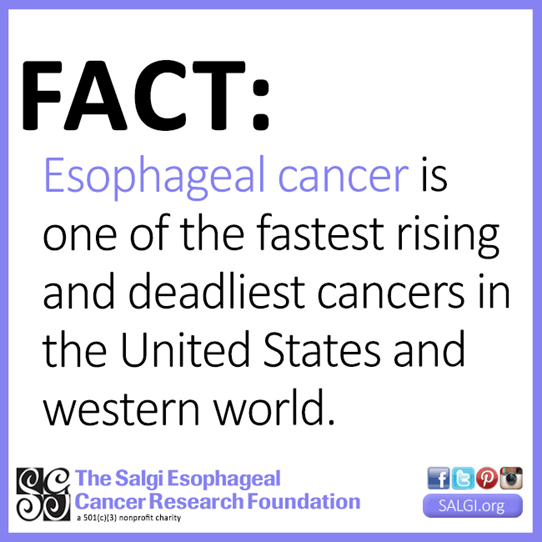
With over a 733% increase in the past four decades, esophageal cancer is among the fastest growing and deadliest cancers in the United States and the western world.1 

There are no current standard or routine screenings to detect esophageal cancer in its earlier stages. Currently, guidelines for referral for endoscopy occur when warning symptoms appear.

These warning symptoms, such as difficulty swallowing, typically appear once the cancer has become advanced.  This, in addition with other factors mentioned, leads to the current overall five-year survival rate of only 21.9%.2  Despite its rapid increase and poor prognosis, esophageal cancer receives insufficient awareness and research funding.
The Salgi Foundation: Past Esophageal Cancer Research Funding

In 2023, The Salgi Esophageal Cancer Research Foundation awarded research funding to Dr. Matthew Stachler and The Regents of the University of California in the amount of $44,742.00 for the project titled: “Determination of inflammatory influences on progression of Barrett’s esophagus and invasive esophageal adenocarcinoma.”

Dr. Stachler’s research seeks to “understand what drives the progression of preneoplastic disease into invasive cancer by applying the many systems developed for studying advanced cancer to premalignant conditions in early evasive disease with Barrett’s esophagus and esophageal adenocarcinoma being a major focus.”

In 2023, The Salgi Esophageal Cancer Research Foundation also awarded research funding to Dr. Nathan Parker and H. Lee Moffitt Cancer Center & Research Institute, Inc., in the amount of $30,000.00 for the project titled: “Exercise prehabilitation for locoregional esophageal cancer.”

Dr. Parker’s research will “evaluate the feasibility and acceptability of PA and RT exercise prehabilitation components among patients preparing for LEC resection; to examine changes in exploratory outcomes over the course of exercise prehabilitation and recovery following therapy and to compare clinical and treatment outcomes to those of a retrospectively identified comparison group that received no formal exercise prehabilitation programming.”

Lastly, in 2023, The Salgi Esophageal Cancer Research Foundation also awarded research funding to Dr. Sazzad Hassan and Indiana University in the amount of $50,000.00 for the project titled: “Overcoming resistance to HER2-targeted therapies in esophageal adenocarcinoma.”

Dr. Hassan’s research will “investigate whether acquired lapatinib resistance in esophageal adenocarcinoma is due to down regulation of heat shock protein 40. These studies might pave the way toward the use of HSP40-glycolytic enzymes interaction targeting as an innovative therapeutic approach to overcome lapatinib resistance.”

In 2018, The Salgi Esophageal Cancer Research Foundation awarded principal investigator, Dr. Donald Low and Virginia Mason Medical Center, grant funding.  Dr. George Hanna of St Mary’s Hospital (Imperial College London) is co-investigator.

The research, which is currently underway, intends to establish a non-invasive test for the detection of esophageal cancer that is based upon the unique signature of volatile organic compounds (VOCs) within exhaled breath and to analyze exhaled VOCs in response to therapeutic intervention in patients.

In 2015, The Salgi Esophageal Cancer Research Foundation issued esophageal cancer research funding to Program Director Dr. Carlos Minacapelli and Rutgers Robert Wood Johnston Medical School.  That research was presented as a poster presentation during Digestive Disease Week in May, 2017.

The Salgi Esophageal Cancer Research Foundation would like to thank all our supporters and donors who believe in this mission and who make these accomplishments possible.  However, this is just the beginning.  The Salgi Esophageal Cancer Research Foundation continuously receives many requests for esophageal cancer research.  We need to continue our efforts to fundraise so that we may continue to fulfill this mission to raise awareness, encourage early detection and fund research.

To make a tax-deductible donation to The Salgi Esophageal Cancer Research Foundation, please visit: SALGI.org/donate.

The Salgi Esophageal Cancer Research Foundation is a 501(c)(3) nonprofit as recognized by the IRS.


April is Esophageal Cancer Awareness Month

April 1, 2025

It’s here!  April is Esophageal Cancer Awareness Month.  

The Salgi Esophageal Cancer Research Foundation is hard at work, and we need your help to make a BIG impact!

Join us as we raise awareness, encourage early detection and fund research of esophageal cancer…in hopes of a CURE™!

Esophageal cancer is one of the fastest growing and deadliest cancers in the United States, United Kingdom and other western countries.

The Salgi Esophageal Cancer Research Foundation awarded two research grants, the first in 2015 and the second in 2018.   The research awarded in 2018, a breath test for esophageal cancer, is currently underway.   

Then in 2023, The Salgi Esophageal Cancer Research Foundation awarded THREE grants for esophageal cancer research. 

We are honored to share that this year, The Salgi Esophageal Cancer Research Foundation has opened our grant funding program again.

All grants are awarded in honor of all who have been affected by esophageal cancer. 

While these are tremendous accomplishments, esophageal cancer research is critically underfunded and medical researchers continuously inquire about funding.  We are looking forward to awarding MORE funding for esophageal cancer research!

In addition, due to lack of awareness and no routine or standard screenings, many individuals typically face advanced prognosis with limited treatment options. 

Now, more than ever, your support is critically needed to enable this charity to fulfill our mission.

When you make a donation to our charity you are directly supporting esophageal cancer awareness, early detection and research. All donations can be made as a one-time donation or can be recurring, are tax-deductible and go to our mission!

Make an even bigger impact! Create your own custom, fundraising page!

Click the “fundraise” button below to get started. 

Learn the Facts

-Esophageal cancer increased 733% in the past four decades.

-Esophageal cancer is one of the fastest growing cancers in the United States and western world.

-Esophageal cancer has an overall 5-year survival rate of only 21.6%.

-There are no routine or standard screenings.

-Symptoms often arise late, once the cancer has spread.

-Stage IV has a survival rate of 5.3%.

-Esophageal cancer research is critically underfunded.

-In 2016, an estimated $1.6 billion was spent on esophageal cancer care in the United States.

-2025 estimates for esophageal cancer: 22,070 diagnoses & 16,250 deaths.

2025 Infographic

Save the infographic below and share it on social media to raise awareness.
Tag us in your posts. @SalgiFoundation

The Salgi Esophageal Cancer Research Foundation is a registered 501(c)3 organization.  EIN: 45-3633809.

Join us on social media!

Follow, like, share and connect with us on social media!

Facebook.com/SalgiFoundation
Twitter.com/SalgiFoundation
Instagram.com/SalgiFoundation
YouTube.com/SalgiFoundation


Learn the Facts About Esophageal Cancer

March 13, 2025

The Salgi Esophageal Cancer Research Foundation believes that educating as many people as possible regarding risk factors, possible warning symptoms, and statistics associated with esophageal cancer will help in the fight to improve early detection and survival.

Fast Facts

-Esophageal cancer has increased over 733% in the past four decades and is considered the fastest growing cancer in the US and western world.

-Risk factors include:

  • Gastroesophageal Reflux Disease (GERD, acid reflux, chronic heartburn),
  • obesity,
  • poor nutrition,
  • tobacco use,
  • excessive alcohol use,
  • Barrett’s esophagus.

-As one of the deadliest cancers, esophageal cancer has a 5-year survival rate of only 21.6%.

-There are no routine or standard screenings to improve early detection of esophageal cancer.

-Symptoms often arise late once the cancer is considered advanced or “distant” (spread to lymph nodes and other organs.)

-Stage IV esophageal cancer has a survival rate of only 5.6%.

-Despite all these facts, esophageal cancer research is extremely underfunded.

-In 2025, an estimated 22,070 will be diagnosed and there will be an estimated 16,250 deaths.

Share our Infographic!

Follow us on social media!

Facebook.com/SalgiFoundation
Twitter.com/SalgiFoundation
Instagram.com/SalgiFoundation
YouTube.com/SalgiFoundation

The Salgi Esophageal Cancer Research Foundation

Donate today! SALGI.org/donate


The Salgi Esophageal Cancer Research Foundation is a 501 (c) (3) nonprofit organization as recognized by the Internal Revenue Service.

Content found on Salgi.org is for informational purposes only. The Content is not intended to be a substitute for professional medical advice, diagnosis, or treatment. Seek the advice of your physician or other qualified health provider with any questions you may have regarding a medical condition.


Sources:
Esophageal Cancer Sees Dramatic Spike.” Gastroenterology and Endoscopy News.  https://www.gastroendonews.com/Inthe-News/Article/10-18/Esophageal-Cancer-Sees-Dramatic-Spike-/53083 

Management of Barrett’s oesophagus and intramucosal oesophageal cancer: a review of recent development. Shanmugarajah Rajendra and Prateek Sharma, Copyright, 2012, National Center for Biotechnology Information, U.S. National Library of Medicine. Bethesda MD, http://www.ncbi.nlm.nih.gov/pmc/articles/PMC3437535  

SEER Cancer Statistics Factsheets: Esophageal Cancer. National Cancer Institute. Bethesda, MD, 2025 http://seer.cancer.gov/statfacts/html/esoph.html  

Survival rates for cancer of the esophagus by stage. 2025, American Cancer Society, Atlanta, GA, http://www.cancer.org/cancer/esophaguscancer/detailedguide/esophagus-cancer-survival-rates  

Barrett’s esophagus and esophageal adenocarcinoma in adults: long-term GERD or something else? Pondugula K, Wani S, Sharma P, Copyright, 2007 National Center for Biotechnology Information, U.S. National Library of Medicine. Bethesda, MD, http://www.ncbi.nlm.nih.gov/pubmed/18377797  

A Snapshot of Esophageal Cancer Trends in NCI Funding for Esophageal Cancer Research. 2025, National Cancer Institute, Bethesda, MD, http://www.cancer.gov/researchandfunding/snapshots/pdf/Esophageal-Snapshot.pdf  

Non-Invasive Detection of Esophageal Cancer using Genetic Changes in Circulating Cell-Free DNA Avicenna Journal of Medical Biotechnology, Vol. 4, No. 1, January-March 2012 http://www.ajmb.org/PDF/En/FullText/76.pdf

The Salgi Foundation Awards Three Esophageal Cancer Research Grants

July 11, 2023

The Salgi Esophageal Cancer Research Foundation has awarded funding for esophageal cancer research in June 2023; the third time in less than 11 years since the charity was founded.

The Salgi Esophageal Cancer Research Foundation issued not one, not two but THREE grants for esophageal cancer research.

In 2011, The Salgi Esophageal Cancer Research Foundation was established to raise awareness, encourage early detection and to fund research of esophageal cancer.  Since 2011, the foundation has both raised awareness and encouraged the importance of earliest possible detection across the United States and internationally.  The Salgi Esophageal Cancer Research Foundation first funded esophageal cancer research in July, 2015 and then again in November, 2018.

Current Esophageal Cancer Research Funding

The Salgi Esophageal Cancer Research Foundation awarded research funding to Dr. Matthew Stachler and The Regents of the University of California in the amount of $44,742.00 for the project titled: “Determination of inflammatory influences on progression of Barrett’s esophagus and invasive esophageal adenocarcinoma.”

Dr. Stachler’s research seeks to “understand what drives the progression of preneoplastic disease into invasive cancer by applying the many systems developed for studying advanced cancer to premalignant conditions in early evasive disease with Barrett’s esophagus and esophageal adenocarcinoma being a major focus.”

The Salgi Esophageal Cancer Research Foundation also awarded research funding to Dr. Nathan Parker and H. Lee Moffitt Cancer Center & Research Institute, Inc., in the amount of $30,000.00 for the project titled: “Exercise prehabilitation for locoregional esophageal cancer.”

Dr. Parker’s research will “evaluate the feasibility and acceptability of PA and RT exercise prehabilitation components among patients preparing for LEC resection; to examine changes in exploratory outcomes over the course of exercise prehabilitation and recovery following therapy and to compare clinical and treatment outcomes to those of a retrospectively identified comparison group that received no formal exercise prehabilitation programming.”

The Salgi Esophageal Cancer Research Foundation also awarded research funding to Dr. Sazzad Hassan and Indiana University in the amount of $50,000.00 for the project titled: “Overcoming resistance to HER2-targeted therapies in esophageal adenocarcinoma.”

Dr. Hassan’s research will “investigate whether acquired lapatinib resistance in esophageal adenocarcinoma is due to down regulation of heat shock protein 40. These studies might pave the way toward the use of HSP40-glycolytic enzymes interaction targeting as an innovative therapeutic approach to overcome lapatinib resistance.”

Learn the Facts About Esophageal Cancer

One of the primary risk factors associated with esophageal cancer is Gastroesophageal Reflux Disease, also known as GERD or acid reflux disease, of which the most common symptom is chronic heartburn.  Other risk factors include obesity, heavy drinking, poor nutrition and smoking and/or use of tobacco products. 

With over a 733% increase in the past four decades, esophageal cancer is among the fastest growing and deadliest cancers in the United States and the western world.1 

There are no current standard or routine screenings to detect esophageal cancer in its earlier stages. Currently, guidelines for referral for endoscopy occur when warning symptoms appear.

These warning symptoms, such as difficulty swallowing, typically appear once the cancer has become advanced.  This, in addition with other factors mentioned, leads to the current overall five-year survival rate of only 19.2%.2  Despite its rapid increase and poor prognosis, esophageal cancer receives insufficient awareness and research funding.

cancer, esophageal cancer, research, cancer research, heartburn, acid reflux, cancer esophagus, esophagus, esophageal

The Salgi Foundation: Past Esophageal Cancer Research Funding

In July, 2015, The Salgi Esophageal Cancer Research Foundation issued esophageal cancer research funding to Program Director Dr. Carlos Minacapelli and Rutgers Robert Wood Johnston Medical School.  That research was presented as a poster presentation during Digestive Disease Week in May, 2017.

In November, 2018, The Salgi Esophageal Cancer Research Foundation awarded principal investigator, Dr. Donald Low and Virginia Mason Medical Center, grant funding.  Dr. George Hanna of St Mary’s Hospital (Imperial College London) is co-investigator.

The research, which is currently underway, intends to establish a non-invasive test for the detection of esophageal cancer that is based upon the unique signature of volatile organic compounds (VOCs) within exhaled breath and to analyze exhaled VOCs in response to therapeutic intervention in patients.

The Salgi Esophageal Cancer Research Foundation would like to thank all our supporters and donors who believe in this mission and who make these accomplishments possible.  However, this is just the beginning.  The Salgi Esophageal Cancer Research Foundation continuously receives many requests for esophageal cancer research.  We need to continue our efforts to fundraise so that we may continue to fulfill this mission to raise awareness, encourage early detection and fund research.

To make a tax-deductible donation to The Salgi Esophageal Cancer Research Foundation, please visit: SALGI.org/donate.

The Salgi Esophageal Cancer Research Foundation is a 501(c)(3) nonprofit as recognized by the IRS.


Fundraising Spotlight: “Beards for Bruce”

November 5, 2015

In November, 2014, Richard Huston and his family started a “Beards for Bruce” campaign in support of his father-in-law, Bruce and his battle with esophageal cancer.   Unfortunately, in September of this year, Bruce lost his gallant fight with esophageal cancer.   Richard said that last year Bruce was “overwhelmed by the love and support demonstrated by family, friends and those who didn’t even know him.”

This year, the family continues the campaign and Richard plans to continue “Beards for Bruce” every November in memory of Bruce to promote early detection of esophageal cancer and to help raise awareness and donations in hopes that someday, they will find a cure.”

The Salgi Esophageal Cancer Research Foundation is honored to fulfill this mission in honor of Bruce and we thank all of Bruce’s family and friends who participate and support the “Beards for Bruce” campaign.  Below is an excerpt from the “Beards for Bruce” fundraising website, created by Richard and his family.   Please join us in thanking Bruce’s family and friends for supporting this cause and help them in their mission to raise much needed funding for esophageal cancer awareness and research by sharing their fundraising website.   Thank you!

Bruce Reavill was a proud Husband, Father, and Grandfather that always made his family the number one priority in his life. He was also my (Richard Huston) Father in Law who was an amazing mentor, father figure, and the head of the family.  An absolutely amazing man that seemed to never meet a stranger and left a positive impact every where he would go and with everyone he would meet. He raised two amazing and beautiful daughters; from countless family vacations when they were young to the two of them graduating college and continuing on in life with successful careers and eventually starting their own families.  Needless to say he was a very proud father and Grandfather.

In 2013 Bruce and his lovely wife Sandy decided it was time to find that perfect retirement home in a desert oasis.  After careful consideration and many options they elected to move to Buckeye, Arizona. This is where they would build the home they always wanted with a pool, room for the grandchildren to visit, and their own souped up golf cart that provided them their number one form of transportation.  Surrounded by the beauty of the desert, the elimination of Minnesota winter, and the beautiful Cooper Canyon golf course was the life of retirement that Bruce and Sandy had worked so hard in life for.

Unfortunately after a few short months in Arizona Bruce noticed that he was having trouble swallowing. Initially Bruce put it off as a bad case of heartburn or indigestion; he realized it was not going away and would warrant a trip to the doctor’s office.  This trip to the doctor changed Bruce’s life forever as he heard the words “you have esophageal cancer”.  The impact on Bruce and our family was immediate and very real.  Bruce is one of the strongest and most loving men I have ever known in my lifetime.  He has set the bar of how a man should be in life never wavering from what is right, what is best for his family, and his strong believe in his faith in God.

After completing weeks of chemotherapy, radiation, and a very difficult surgery we had thought he was clear of this horrible decease.   At his 90 day post exam his PET scan revealed that the cancer had now spread to other parts of his body to include his throat, liver, and bones. The reality of being so far away from family during this very difficult time had taken its toll. So this past winter Bruce and Sandy decided to move back to Minnesota where they could be closer to friends and family.  Bruce vowed that he would be Warrior through this process and fight with all his heart.

Bruce would continue chemotherapy, more radiation, and almost daily trips to the doctor’s office. Bruce was a true warrior, a fighter, and a champion who gave it his all with the pride and style that only Bruce could. Unfortunately in September Bruce lost his gallant fight with esophageal cancer.  He was a great man that was loved by so many and who will always be missed from this earth.

Last year I organized the Beards for Bruce campaign in support of Bruce’s battle with Cancer.  Bruce was overwhelmed by the love and support demonstrated by family, friends and those who didn’t even know him. Many of you participated, donated, and provided support for Bruce last year.  For some of you, this may be the first time reading Bruce’s story.   I plan to continue Beards for Bruce every November in memory of Bruce to promote early detection of Esophageal Cancer and to help raise awareness and donations in hopes that some day they will find a cure.

I am reaching out and asking for your support in Bruce’s memory and to further esophageal cancer research.  For all of you who can take part in growing some facial hair in the month of November,  let’s grow out our beards, mustaches, goatees, or in honor of Bruce’s younger years a horseshoe mustache (handle bars) to raise cancer awareness.

We have elected to have all donations to go to The Salgi Esophageal Cancer Research Foundation.  All donations go directly to raise awareness, encourage early detection and to fund research of esophageal cancer…in hopes of a cure.™

I hope you will support me and my family in effort to reach my goal by using the links provided for donations.

Thank you for your love and support!


To visit the “Beards for Bruce” fundraising page, please click here: https://www.crowdrise.com/beardsforbruce/fundraiser/rickhuston


https://www.crowdrise.com/beardsforbruce/fundraiser/rickhuston


Foundation Reaches Milestone: Issues Esophageal Cancer Research Funding For the First Time.

July 28, 2015

The Salgi Esophageal Cancer Research Foundation has issued its first round of funding for esophageal cancer research earlier this month.

The foundation awarded program director, Dr. Carlos Minacapelli and Rutgers Robert Wood Johnston Medical School grant funding.

In 2011, The Salgi Esophageal Cancer Research Foundation was established to raise awareness, encourage early detection and to fund research of esophageal cancer.  Since 2011, the foundation has both raised awareness and encouraged the importance of earliest possible detection throughout New England, across the United States and internationally.

“The Salgi Esophageal Cancer Research Foundation is excited to be a part of Dr. Minacapelli’s and Rutger’s research efforts in honor of all the brave men and women who were affected by esophageal cancer and to hopefully reduce incidence and improve outcomes for individuals in the future” President of the foundation stated.

The Salgi Esophageal Cancer Research Foundation would like to thank all of our supporters and donors who believe in this mission and who make these accomplishments possible.  However, this is just the beginning.  We received many other research requests that we were unable to fund at this time.  We need to continue our efforts to fundraise so that we may continue to fund research.

Gastroesophageal Reflux Disease, also known as GERD or acid reflux disease, of which the most common symptom is chronic heartburn, is one of the primary risk factors associated with esophageal cancer.  Other risk factors include obesity, poor nutrition and smoking.  With over a 600% increase in the past decades, esophageal cancer is among the fastest growing and deadliest cancers in the United States and western world.

Currently, there are no standard or routine screenings to detect esophageal cancer in earlier stages. Symptoms, such as difficulty swallowing, typically appear once the cancer has become advanced and the overall five-year survival rate is only 17.5%.  Despite its rapid increase and poor prognosis, esophageal cancer receives very little awareness and research funding.

To make a tax-deductible donation to The Salgi Esophageal Cancer Research Foundation, please visit: SALGI.org/donate.


“Clinical Trials Actively Recruiting Patients With Esophageal Cancer,” The ASCO Post

March 26, 2015

By Liz Janetschek | The ASCO Post.  March 25, 2015, Volume 6, Issue 5

The information contained in this Clinical Trials Resource Guide includes actively recruiting observational, interventional, phase I, phase II, and phase III clinical studies for patients with newly diagnosed or recurrent esophageal cancer. All of the studies are listed on the National Institutes of Health website at ClinicalTrials.gov.

Read the full article, “Clinical Trials Actively Recruiting Patients With Esophageal Cancer,” The ASCO Post.


The Salgi Esophageal Cancer Research Foundation is a 501 (c) (3) non profit organization as recognized by the Internal Revenue Service.

Content found on Salgi.org is for informational purposes only. The Content is not intended to be a substitute for professional medical advice, diagnosis, or treatment. Seek the advice of your physician or other qualified health provider with any questions you may have regarding a medical condition.


When it comes to Esophageal Cancer Prevention, All Pizzas are NOT Created Equal

November 12, 2013

There has been a lot of talk regarding pizza and its link to cancer prevention, specifically esophageal cancer prevention. While this new finding is quite exciting to pizza fans, it needs to be carefully explained, as all pizzas are not created equal when it comes to esophageal cancer prevention.

Silvano Gallus, PhD is an epidemiologist at the Instituto di Ricerche Farmacologiche “Mario Negri,” in Milan, Italy and lead researcher of a study which focuses on the benefits of the Mediterranean Diet: “Does pizza protect against cancer?

Gallus stated in a recent article from WebMD that “Italian pizza is less than 50% crust, 20% tomato sauce, 20% mozzarella cheese, and 4% olive oil” and continued that Italian pizza “is very different from fast-food pizza.”

In fact, you can sometimes even find more than triple the amount of calories and fat in an American pizza than one found in a Pizzeria in Italy. “Traditional Italian Pizza” has a thin crust which is made from flour, yeast, water, olive oil (and nothing else) and topped with tomato sauce and a small serving of mozzarella.

This “fast-food pizza” found in America has a thicker crust made with refined carbohydrates, added preservatives, unhealthy oils and fats, and much heavier toppings. Gallus notes in the article that those refined carbohydrates have also “been directly associated with cancer of the upper digestive tract and colorectal cancer.” Gallus stated that there is “limited information on the potential influence of pizza and cancer risk.”

However, lycopene which is found in cooked tomatoes and olive oil has been proven to have the potential to not only reduce the risk but to also slow the growth of some cancers.

The study showed “regular pizza eaters had 34% less risk of oral cavity and pharyngeal cancer, 59% less risk of esophageal cancer, and 25% less risk of colon cancer.”  So it seems that in actuality, certain types of pizza which are low in fat, high in nutrient may help you lower your risk of esophageal and other cancers. This is not surprising given the research conducted regarding the health benefits of a Mediterranean diet.

Want to make your own Italian thin crust pizza at home? Check out this great recipe from Walks of Italy’s website: How to Make an Italian Pizza: The Simple, Step-by-Step Guide

To read WebMD’s full article, “Pizza Prevents Cancer?” Click here


The Salgi Esophageal Cancer Research Foundation is a 501 (c) (3) non profit organization as recognized by the Internal Revenue Service.

Content found on Salgi.org is for informational purposes only. The Content is not intended to be a substitute for professional medical advice, diagnosis, or treatment. Seek the advice of your physician or other qualified health provider with any questions you may have regarding a medical condition.


November is GERD Awareness Month!

November 5, 2013

Gastroesophageal Reflux Disease (GERD) is among a handful of risk factors associated with the development of esophageal cancer.   Many experience heartburn, with too many experiencing heartburn on a regular basis.  If not treated properly, heartburn can be very damaging, leading to a number of diseases, including esophageal cancer.

November is ‘GERD Awareness Month’!  Our friends at The Miriam Hospital published an article regarding GERD and “What you need to know!”

Brett Kalmowitz, MD, gastroenterologist at Rhode Island Hospital and The Miriam Hospital says: “Heartburn or acid indigestion is the most common symptom of GERD.” Kalmowitz further explains that “heartburn is a burning chest pain that begins behind the breastbone and moves upward to the neck and throat. It can last as long as two hours and is often worse after meals. Lying down or bending over after a meal can also contribute to heartburn.”

Raising awareness for GERD is such an important step in the fight against esophageal cancer.   Remember to share this post with your friends, family and social media sites, too!  Use the links at the bottom to post, tweet, email and pin directly from this page.

To read The Miriam Hospital’s full article, Gastroesophageal Reflux Disease (GERD), click here.


The Salgi Esophageal Cancer Research Foundation is a 501 (c) (3) non profit organization as recognized by the Internal Revenue Service.

Content found on Salgi.org is for informational purposes only. The Content is not intended to be a substitute for professional medical advice, diagnosis, or treatment. Seek the advice of your physician or other qualified health provider with any questions you may have regarding a medical condition.